
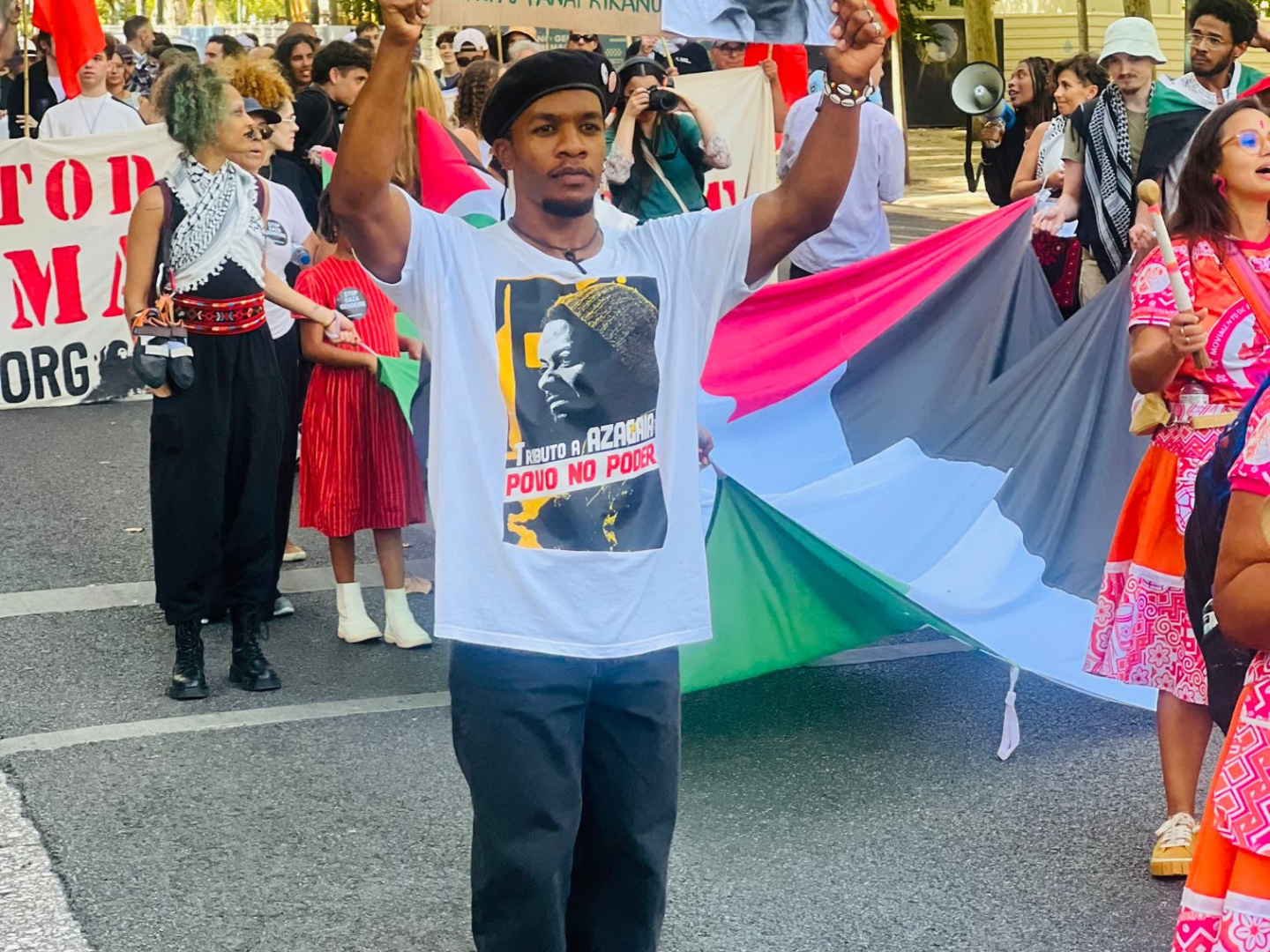
In 2020, BBC World Histories Magazine set out to elect the most important historical leader in the world. To this end, it invited a group of historians to present their proposals, which were subsequently submitted to a vote by more than five thousand readers. Amílcar Cabral came in second place in this vote, ahead of Winston Churchill and Abraham Lincoln. Here in Portugal, his legacy is far from being remembered in the same way, in a neglect that begins in school, shrouded in a narrative that, even after April 25th, characterized liberation movements and colonized peoples as "violent," without politically contextualizing their struggles.
It is precisely to remember the legacy of the historic leader of the African Party for the Independence of Guinea and Cape Verde (PAIGC, in the original acronym) and the importance of studying him that, on the 12th, the Konferénsia Panafrikanu di Lisboa, of which Apolo is a part, along with other movements, will take to the streets. Formed in 2018, in the aftermath of the demonstrations against slavery in Libya that took place the previous year, the Konferénsia Panafrikanu di Lisboa emerges as a space for the revitalization of Pan-Africanism in the Portuguese capital, a theme that Apolo has been working on, both from an academic perspective (he is a doctoral candidate in post-colonial studies at the University of Coimbra), and through the lens of social movements, whose role he considers crucial in the study of these themes.
This year's Marxa starts from the relationship between the ecological question and colonial history. How do these two dimensions intertwine?
We believe that these dimensions are part of the liberation struggles and the anti-racist and Pan-Africanist struggle itself, but they have had less visibility among us. When I say less visibility, I don't mean that this concern is not within the struggles of African peoples, post-colonized peoples, indigenous peoples, etc. On the contrary, the defense of the land has been central and daily in the lives of these people for a long time.
What happened is that the ecological question, especially within the European context, ended up being presented as an agenda separate from the issues that interest us and that affect us, such as colonialism and racism, here in this still Eurocentric space. And the ecological movement ended up gaining greater public visibility from white movements, that is, we tend to associate ecological movements with white movements.
This ended up erasing other origins or genealogies of the ecological struggle. And we, with this Marxa, especially based on the scientific work of Amílcar Cabral, want to do the opposite, which is to recover the ecological question within the history of liberation struggles and show that we cannot stop the climate crisis without asking the essential question, which is that of responsibility: who exploited the land, who appropriated the resources and carried out this predatory accumulation of wealth with the consequences we face today. And there, we will return to Cabral. I also want to make a point here: we are not going to transform Cabral into a bastion of 21st-century ecology at all. We have this understanding of contexts, but I think it is very important to show that the totality of liberation, because [the liberation movements] advocated for total and immediate liberation, also included the ecological dimension, because it was not only about separating the independence of our countries and people, but also the independence and liberation of the land itself as a whole, this almost cosmological dimension. Cabral was an agricultural engineer and worked with people in the Alentejo region, and also in Alcântara, with farmers. He also did work in Guinea-Bissau, so it's interesting to see that Cabral went to the rural world to find the foundations for his own struggle. When he says, in his agrarian writings, that defending the land is defending humanity, this shows the relevance of his thinking today. And nowadays, those who have actually suffered from the ecological consequences are still, in a way, the colonized people. Hence the pertinence of his thought.
Cabral's studies in agronomy and the way he studied the land also allow us to have a very concrete understanding of what extractivism associated with colonialism was like.
Yes, he talks in his writings about the issue of soil erosion, and he also has this very scientific notion that the fact that we are human beings means that in nature, obviously, there will be erosion of the space we inhabit, even simply by walking. Animals also cause this erosion. He's not very purist about it. But there is a type of erosion that is more predatory, more damaging. And there is a plantation economy, like the one that happened in São Tomé and Príncipe, for example, which was one of the genealogies of this climate crisis or this ecological crisis.
There is often talk of an Anthropocene, and we completely reject this term because, while the defense of the Earth is indeed the responsibility of all human beings, since we inhabit this single planet, we do not accept that responsibility for the damage to this Earth should be attributed to us. Those who have actually destroyed and continue to destroy this planet are the Global North, the countries that initiated and continued imperialism, capitalism, etc. African countries contribute less than 4% of carbon emissions, but they are the ones that suffer most from climate change. And we can also look at Atlantic islands, such as Vanuatu or Tuvalu, which are almost disappearing because of this extractive industry.
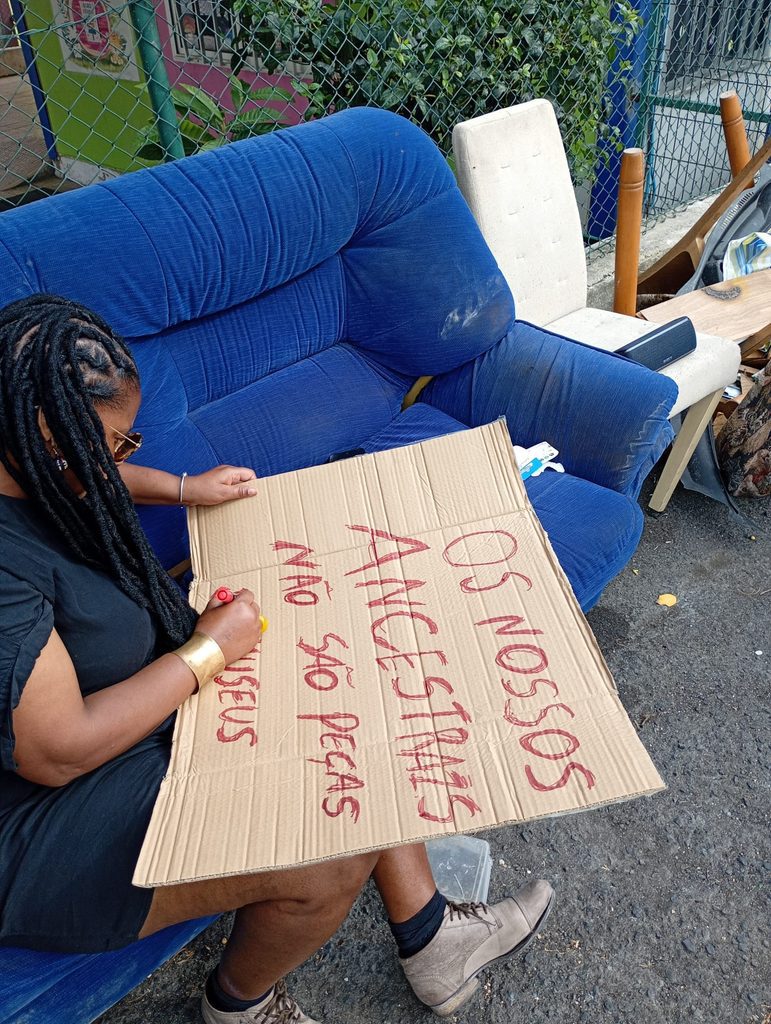
Preparation for this year's March
Photograph provided by Apolo de Carvalho
Another objective is to bring the discussion about reparations to the streets, a topic that has been heavily appropriated by the far-right, amidst the surrounding media noise. How do we overcome this noise barrier and move towards a truly serious discussion on the subject, one that can be heard?
It's interesting to consider the question of making ourselves heard, because [we can ask] who we are speaking to. In Marxa Cabral (and that's why we use the term Marxa and not Demonstration), our interlocutor is not the far-right. The far-right has very fixed ideas, not because they don't know the truth, but because there is an ideology of separation of life, of hierarchizing lives that doesn't interest us. Therefore, they are not our interlocutor. Our interlocutor, just as during the struggle for liberation, is society. It is the workers. It is all the people who recognize themselves in the struggles for liberation and for the dignity of the human being.
Reparation is a fundamental principle of justice and dignity. When there is harm, there is an obligation to acknowledge it and seek to repair it. This is not an extraordinary idea invented by us now; contemporary European history itself is full of reparation processes. After the Second World War, there were reparations and indemnities related to crimes, mainly in Europe itself. Now with Ukraine, there have been, and rightly so . And the question we must ask is: "Why is it that when we get to slavery and colonialism, and their effects on peoples – this is not about the past, but about the present – this same idea is presented as if it were something anachronistic, that has nothing to do with us, but with our ancestors?", or is even seen as an absurd topic. Obviously, people need to see reparation as an urgent matter so that we can build a new society. We cannot wipe the slate clean of what happened and move on. The present, the past, and the future are cyclical; therefore, to move towards a shared future, we must do this work. And for us, repairing something is not limited to calculating a financial value for what happened centuries ago, because that is irreparable. But because it is irrepairable, it must be repaired, right? The damage is not only to the past; there are still material and economic consequences today that span generations and reveal the inequalities in Portuguese society.
We recently had the case of Odair Moniz, whose life was taken by the State, by the armed wing of the State. The guilt of this armed wing of the State is acknowledged, but then there are no consequences, and the agent is not only exonerated but returns to his duties. What kind of message are we sending? We are sending a message that there is a hierarchy of life, and that there are lives that do not deserve consideration, lives that are worthless and that we do not even recognize; that is, recognition and reparation are very much linked here. The dignity of Odair Moniz's life was not recognized, and because the dignity of his life was not recognized, there is no reparation. Therefore, we believe that reparation must be seen as an urgent matter, but in all its dimensions. Not only in this financial matter, it's not just about that, but about the material living conditions of the people who are building and have built this country. Who built Lisbon? Who cleans Lisbon? These are people who were colonized and who still live on the margins and periphery of society. It is Black women, it is Roma people who continue to be considered as less valid lives and not worthy of reparation. And all of this is still about the present. Portugal has not decolonized. It is no coincidence that we put the D of decolonize [in Marxa's motto]: it is the rescue of the D of Decolonize from April 25th. When we look at Lisbon, it is a profoundly colonial city. From the monuments to the names of the streets and all the architecture of the city. The anthem, the flag and June 10th show that there was a revolution, but many of the structures that in a revolution are supposed to be broken to create new things, remained. And this still colonial relationship with the people who were enslaved continues. Hence, this articulation, recognition, reparation and decolonization are mottos that we wanted to bring to the streets also as a way of saying no to Portugal. The United Nations General Assembly, due to a resolution presented by Ghana, declared transatlantic racialized slavery as the most serious crime against humanity, and Portugal, which was a pioneering country, along with Spain, in this endeavor, abstained. This is a failure to recognize it. And when we agree that it is the most serious crime against humanity, it doesn't mean we are hierarchizing crimes against humanity. It's because, in fact, the only slavery in which people were considered as movable property, as objects – not even as people – was this slavery. All peoples have enslaved, we know that, but the only slavery that denied dignity and belonging to humanity to African people was the transatlantic slave trade which, moreover, also enslaved the land itself, the so-called Capitalocene and the Negrocene that we can think of.
Earlier, when I mentioned the issue of the far-right, I wasn't referring to dialogue with the political force itself, but to the people reached by its discourse. Could this reach hinder a serious debate in society on these issues?
Yes, when I say we need to change our interlocutor, that doesn't mean we have to completely ignore the impact the far-right has, because it has an impact even within racialized communities, and we've seen that globally. I think Cabral, again, teaches us to change the discourse, to find ways to reach people. When he said that the fight against colonialism wasn't a fight against the Portuguese people, but a fight against Portuguese fascism, which even oppressed the Portuguese themselves, I think he gives us a very important message about the need to create alliances at different levels between peoples. And going back to this issue of reparations, beyond everything related to material issues, reparations should be seen as the practice of relationship. We didn't have a common history because we share the Portuguese language – and even the Portuguese language isn't common, the one I speak and the one you speak, for example. There are differences here because there was a different history.
Now the question is how can the peoples who have experienced these fractures come together again? How can we come together again here in Portugal? We, Black people, Roma people, white people, working people, how can we create alliances again and find common ground? And I think the far-right has been diverting us from the essentials, that is, who has oppressed us, who has been our common enemy and impacted our lives, in terms of housing, employment, and health. These are issues that affect us all, but which the far-right uses to divide us. And I think Marxa Cabral has this very strong concern to say that we share the world, that this world belongs to us, and that we cannot go anywhere else, we only have this planet to inhabit and [we need] the union of all the wretched of the earth, of all the workers of the world, of all pan-Africanists. Pan-Africanism conveys this global message: it's not just about Africa and Africans, it's about the alliance with the global south. How can we not only question this world and fight against it, but also build spaces for coexistence? How can we rediscover a common people and, above all, how can we recognize Amílcar Cabral as a common ancestor? The Portuguese can look to the past and seek out moments and people who brought people together, who converged in this people, and Cabral is one of those faces that can allow Portugal, the African countries that speak Portuguese, and people of African descent to find common ground here. If we don't see ourselves reflected in the flag, if we don't see ourselves reflected in the anthem, we can see ourselves reflected in historical moments of struggle and in people.
Cabral is almost a plural, a singular plural. He ends up bringing together all these struggles. It's not about Cabral as a person, it's about his thinking, his method of struggle.
Regarding the Pan-Africanist Declaration of Lisbon, which will be presented and read during Marxa, what are the key points and which groups endorse it?
We sent it to several collectives and the list will remain open until tomorrow [September 5th]. But we already have about 10 or 11 collectives, such as Peles Negras Máscaras Negras, SOS Racismo, Afrolink, and also Banderinha Panafrikanista, a group of women drummers who are also promoters of Marxa.
Regarding the points, it's an internationalist declaration that seeks to encompass various struggles. [It includes] this articulation between the ecological question and the colonial question, and above all, this question about what aspects of the colonial order remain organized in our present. Therefore, these three words—Recognize, Repair, and Decolonize—are articulated to show us that we can no longer think about the material liberation of our lives, the issues of health, housing, and transportation, separately from the ecological question. All the struggle we are waging against racism, against discrimination, is being waged within this planet, within this common home. For example, COVID-19 showed us that although the virus affects everyone, the consequences were different for some than for others. Within a pandemic or an ecological crisis, we all die, but those who die first in the most degrading conditions are racialized people, Roma people, people from the Global South. Therefore, we must bring our home, which is this planet, to the center of our struggles. And we truly want to make that return. To rescue, or recover, or return, using the Cabralist term. To bring back this ecological issue of climate urgency to our struggles, remembering that this was already part of our struggles long, long before.
Reparation is very important in this because it's a program of absolute disorder; it's about destroying all the mechanisms that have allowed the destruction of our material living conditions.
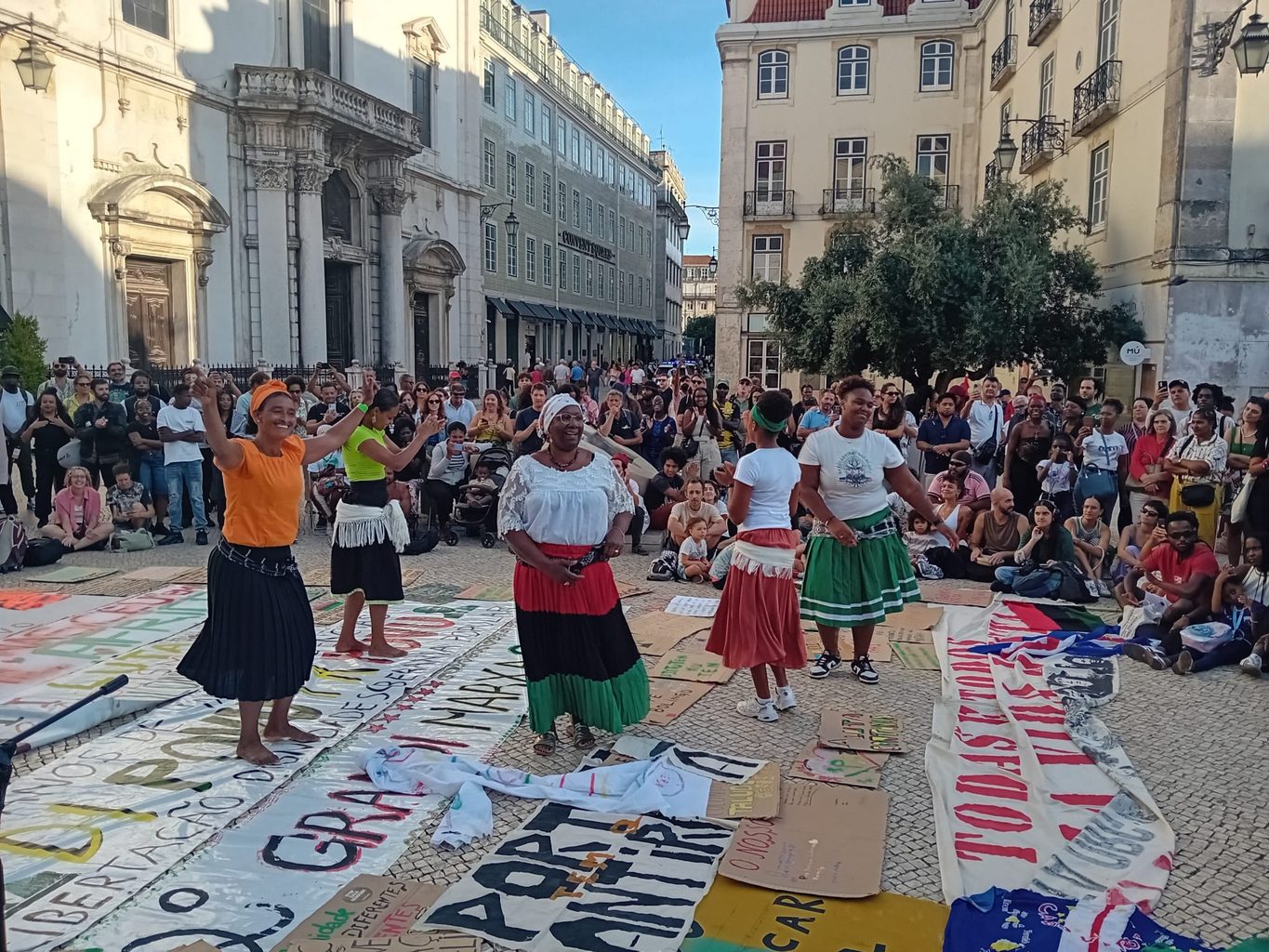
March of 2025
Photograph provided by Apolo de Carvalho
Cabral was labeled a "terrorist" by the dictatorship, within a colonial narrative of those who felt threatened by liberation movements. Does this narrative still resonate in society and academia today? Or is Cabral so forgotten in Portuguese society that there isn't even a narrative about his thought?
A: Probably both. There is still this legacy of Cabral as a "terrorist," but there is also an erasure of the memory of Amílcar Cabral and the entire liberation movement. This is true in Portugal and all over the world, but since we are in Portugal, we will talk more about Portugal. There is no point in bringing up this figure, because Cabral is a unifier of all struggles, of all peoples, and in a society where the far-right and fascism are increasingly growing and feeding on division, a figure like Amílcar Cabral is a threat because his name alone completely dismantles those projects. That is why, when we began, in 2024, around the time of the centenary, to say that the 25th of April was born in Africa and that Amílcar Cabral should be recognized as one of the faces of Portuguese history and democracy, it was precisely to say that this country has an arsenal to fight the threats of the present and the future, which are fascism and the far-right, that it can still use. Our goal is not merely to turn Cabral into a statue, nor just to honor Cabral; it is to encourage the serious study of Amílcar Cabral because his writings and speeches, although dating from a specific era, are still very relevant today. For me, Cabral is not just the person himself, he is a method and a thought-action, he is knowledge. He insisted on the need to deeply understand the concrete reality we want to transform, and above all, not to import formulas or abstractions into our struggle, but to be with the people, to be on the ground, to develop these social relationships, to perceive the concrete contradictions of our reality in order to be able to fight. His career as an agricultural engineer ultimately demonstrated this: he studied the soils, the agricultural and material conditions of the people in order to propose a struggle, and he managed to create connections with the farmers in Guinea-Bissau based on this study. Therefore, the Cabralist method is exactly that: to know our reality deeply and critically so that we can transform it according to the conditions of that space. We can learn from life, learn from books, learn from the experience of others, but we must also stand on our own two feet and think for ourselves. Cabral ultimately gives us a method of thinking about contemporary struggles in a very interesting way that also articulates [Frantz] Fanon, because it is a struggle that affirms that we are here to critically reflect on our reality, but in order to transform it. This happened during the struggle for liberation. While the struggle continued, a pilot school was being built, children were being spoken to—in other words, the country that was envisioned was being built—and I think that's what we need to do today. While fighting against the far-right, we celebrate our unity and demonstrate who we are. That's why Marxa has a moment of cultural expression, with drumming, music, and poems, where we celebrate who we are. It's not just about saying that this is not right. It's not, but we are proposing new things for ourselves, hence the importance of culture.
You mentioned earlier that it's important to encourage the study of Cabral's work. Is academia open to this, considering he left behind such a vast body of theoretical work?
Yes, I think academia has become more open, largely thanks to the struggles of social movements. The study and production of books and research is not exclusive to academia; it has been happening in many spaces: We have the Amílcar Cabral Foundation in Cape Verde, which has done tremendous work in preserving his writings and legacy; we have Tricontinental, an organization that has been working on Cabral's thought for a long time; in South Africa, there is a collective called Abahlali baseMjondolo, where Cabral's thought is extensively studied; and in Brazil as well.
But in Portuguese academia it's different…
That's where I was heading. Within academia, due to these resonances coming from outside and from the movements – the Ghetto Platform was already studying Amílcar Cabral – the seed planted by the movements began to spread to academia, and today there is indeed a very interesting body of work on Amílcar Cabral, but more is needed. We politicize dissatisfaction; it's never enough, but we recognize that there is indeed a path being followed, with various conferences, such as those held around the time of the centenary. But there is also a danger here: academia cannot capture Amílcar Cabral, because Cabral belongs to the people, Cabral belongs to the world, and often when this type of radical thought, from the radical Black tradition, enters academia, it ends up going through the washing machine and all its power risks being erased. This doesn't mean that all of academia does this. I am also within academia, and there are many critical people interested in the radicalism of this struggle, and note that radicalism is different from extremism. It's always very diverse, but I think the most interesting thing is not only what academia has done, but how Cabral has been present in social movements, above all, and within batuco. The batucadeiras, nowadays (and batuco as a system of thought), have been educators of Amílcar Cabral's struggle through music and dance, with a very complex critical thinking that is important for us to observe, also to do this cognitive justice.
To what extent does Cabral's thought help us interpret not only what Portuguese colonialism was, but also what remains of it today? In other words, to what extent does his thought help us understand the legacy left by Portuguese colonialism and its place within history?
Cabral was a great scholar and had this notion that the struggle had to be scientific. He advocated the production of critical thought about the world, which should be shared by all people, not only intellectuals, but the people themselves; hence the importance of education within the struggle for liberation. It is important to study deeply using methods from the field, and also from other parts of the world. It is important to know our history deeply. Portugal does not transform itself because Portugal deliberately has a very limited understanding of its history, of the protagonists of its history. And when we do not study all dimensions of our history deeply, we cannot build a transformative present that includes all people. Cabral's thought, and everything he represents as a pedagogue of the revolution, informs us that it is still necessary to go to the archives – and these archives are not only written, they are people who are still alive – and begin to transform this reality, and this is a capitalist, patriarchal reality that produces ecocide, in a way. This issue of imperialism is increasingly present. It is no coincidence that today we are increasingly standing alongside the Palestinian people in their struggle, but even back then Cabral expressed solidarity with the Palestinian people in a very concrete way – it is also our struggle. And he did this with several other peoples. We are at a moment when it is necessary to affirm this solidarity with all peoples in struggle because what happens there also happens here and concerns us, and this includes new forms of oppression. The idea of the dignity of the human person, which Cabral and the entire liberation movement held, is very interesting because it opens up the perspective that, in this patriarchal, capitalist, and colonialist world, new forms of oppression may arise, and we must develop a method and an ideology capable of anticipating and protecting us against these new forms of oppression. In Amílcar Cabral's time, we didn't have social media, we didn't have the internet, and we are seeing that with the internet and artificial intelligence, new ways of amputating people's humanity are emerging, and we need to return to those archives so that we can be inspired to transform this reality.