
Support Gerador in building a more creative, critical and participatory society. Find out how here.

Barometer to the Millimeter: The actors and actresses that the Portuguese most admire

To be aware of the preferences of the Portuguese, or the lack thereof, in relation to authors and…

Text by Clara Amante

Support Gerador in building a more creative, critical and participatory society. Find out here.

Being aware of the preferences of the Portuguese, or the lack thereof, in relation to national authors and artists, can be an important tool for assessing the health of the country's culture.

In the "Cultural References" section of the Barometer Gerador Qmetrics 2021, we analyzed which actors, musical artists, visual artists, writers, directors and comedians the Portuguese admire the most. Today, we tell you what the results were in the area of ​​acting.

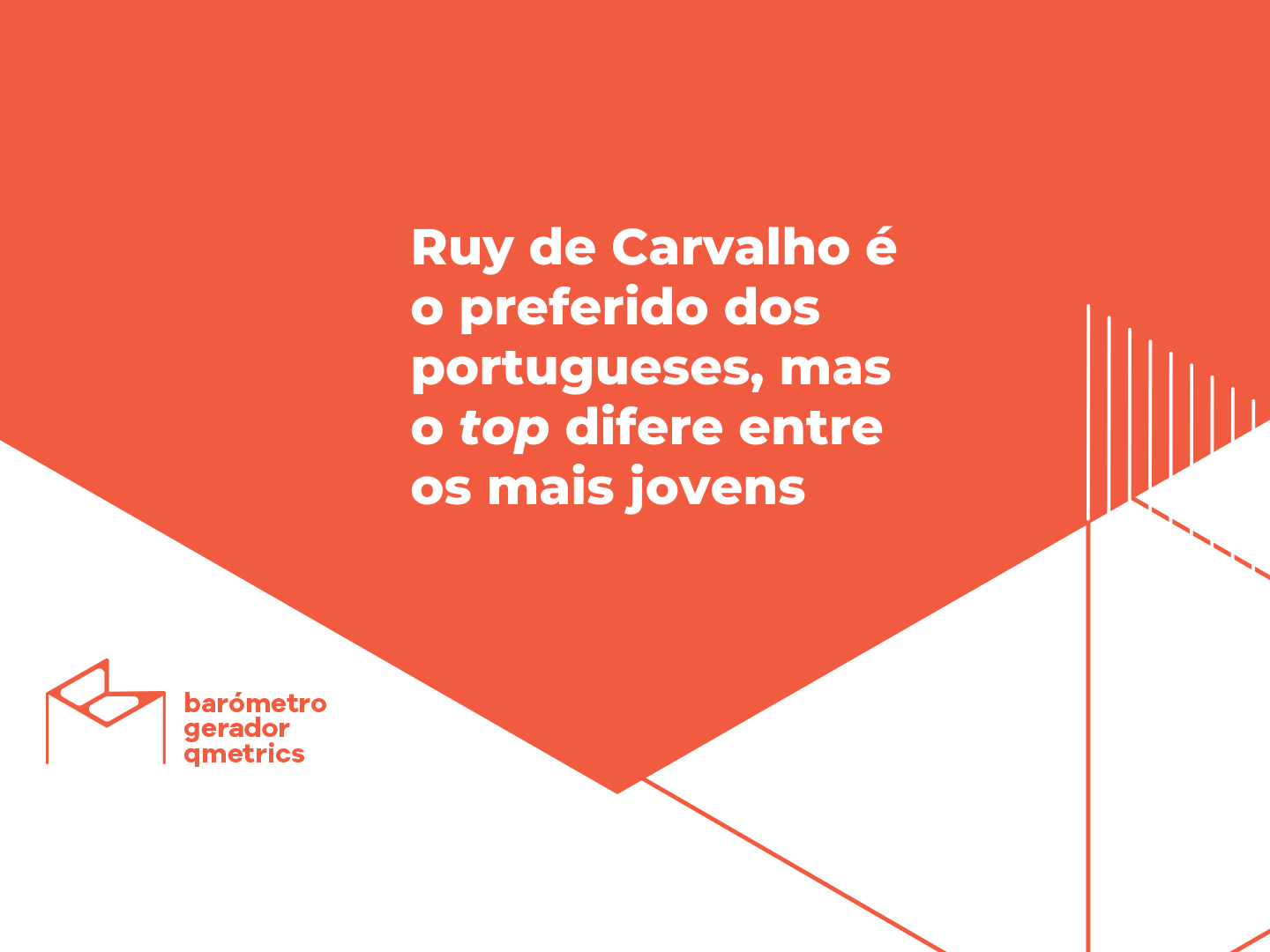
For the third consecutive year, Ruy de Carvalho remains in first place among the Portuguese.

The rest of the Top 10 changes from year to year, although the same names largely appear. This is a Top 10 made of balance, with an equal presence of men and women and a more or less equivalent number of actors and actresses from different generations, something that doesn't happen in all the artistic areas analyzed.

On the other hand, the list of favorite actors among younger people is radically different from the general list. Kelly Bailey and Ricardo Pereira, who do not appear in the Top 10 of general references, are the actors that young Portuguese people admire most. Ruy de Carvalho, on the other hand, moves to the bottom of the list when it comes to this age group.

Every two weeks we dive into the Barometer Gerador Qmetrics to bring you new analyses on the relationship between Portuguese people and culture. Stay tuned for upcoming articles!

O Barometer Gerador Qmetrics is an annual study that analyses Portuguese people’s opinions on culture. First carried out in 2019, this year’s survey focused mainly on the consequences of the pandemic on society and culture. Find out more about the 2021 report here and ask for your full report here.

Summary Technical Sheet

The study universe consists of individuals aged 15 or over, residing in mainland Portugal and the islands. The sample, with 1.200 validated interviews, was stratified by region, sex and age group, in mainland Portugal, and by islands, and distributed in each stratum according to the distribution of the target population in each stratum. The interviews were conducted from March 22 to April 27, 2021, through an online questionnaire using the CAWI (Computer Assisted Web Interview) method. The results are presented with a 95% confidence level. The margin of error for the mean on a scale of 1 to 10 is 0,13 points and the margin of error for the proportion is 2,12 percentage points.
Advertise with us!

If this article interested you, it's worth checking out these too

April 28th 2023

Barometer to the Millimeter: Perception of the cultural offer in the different regions of the country

April 14th 2023

Barometer to the Millimeter: People with more financial resources dine out more often

24 February 2023

Barometer to the Millimeter: What are the best means for cultural communication in Portugal?

January 17th, 2023

Barometer to the Millimeter: Education and financial comfort are the most relevant factors

20 December 2022

Barometer to the Millimeter: Proactive and Reactive Cultural Consumption

6 November 2022

Barometer to the Millimeter: The impact of mental well-being and fatigue on cultural consumption

17 February 2022

Barometer to the Millimeter: Who do the Portuguese consider to be the best visual artists?

30 December 2021

Barometer to the Millimeter: The Portuguese’s favorite writers

16 December 2021

Barometer to the Millimeter: Who are the musical artists most admired by the population?

2 December 2021

Barometer to the Millimeter: How do the Portuguese find out about cultural events?

Academy: Gerador Critical Thinking Program

JANUARY 30 TO FEBRUARY 15 2024

Literary Journalism: From the power of facts to narrative beauty [online]

Duration: 15h

Format: Online

JANUARY 30 TO FEBRUARY 15 2024

Course: Politics and Citizenship for Democracy

Duration: 15h

Format: Online

JANUARY 30 TO FEBRUARY 15 2024

Imagination Workshop to Understand the Future

Duration: 15h

Format: Online

JANUARY 30 TO FEBRUARY 15 2024

Financing of Cultural Structures and Projects [online]

Duration: 15h

Format: Online

JANUARY 30 TO FEBRUARY 15 2024

Media Literacy Workshop

Duration: 15h

Format: Online

JANUARY 30 TO FEBRUARY 15 2024

Creation and Maintenance of Cultural Associations

Duration: 15h

Format: Online

JANUARY 30 TO FEBRUARY 15 2024

European Funds for Arts and Culture I – from Idea to Project [online]

Duration: 15h

Format: Online

JANUARY 30 TO FEBRUARY 15 2024

Introduction to video – filming, cutting and editing [online]

Duration: 15h

Format: Online

JANUARY 30 TO FEBRUARY 15 2024

Journalism and Music Criticism [online]

Duration: 15h

Format: Online

JANUARY 30 TO FEBRUARY 15 2024

Anti-Disinformation Book Club 

Duration: 15h

Format: Online

JANUARY 30 TO FEBRUARY 15 2024

Cultural Communication [online]

Duration: 15h

Format: Online

JANUARY 30 TO FEBRUARY 15 2024

Decluttering your writing: practical workshop [online]

Duration: 15h

Format: Online

Investigations: discover our main reports, made with slow journalism

April 20, 2026

Higher education: future or space of uncertainty?

For many young people, higher education remains the natural, almost obligatory, path to securing a better future. Despite this, not all who choose this path find a reality that meets their expectations. In this project, we seek to understand, through in-depth reporting and video testimonies, what is really at stake in higher education in Portugal. What is driving young people away? What makes them stay or leave? And, above all, what kind of country are we building when studying becomes a privilege or a risk?

February 16 2026

With government sponsorship, disinformation in Slovakia is affecting people, values, and institutions.

Attacks on journalists, discrediting of independent media, spread of misinformation, dismantling of cultural institutions. Disinformation in Slovakia is growing with the sponsorship of political leaders, who bring marginal narratives into the mainstream . With attacks and tailor-made legislative changes, the polarization of society is intensifying, harming democracy and pro-European sentiment.

Shopping cart0
There are no products in the cart!
Continue in store
0